|
SILO 2.4 (DRAFT)Year 2, Term 4: AlgorithmsScope and sequence: Algorithms, Iteration, TessellationsFocus: Algorithms |
||
Learning
intention: Students
explore patterns as an introduction to algorithms.
|
||
|
NSW Syllabus
|
Australian Curriculum
|
Ontario Curriculum
|
|
"A student describes, follows and
represents algorithms to solve problems" (Science and
Technology, Digital Technologies, Year 3, ST1-3DP-T).
|
"Students learn to design
algorithms involving multiple alternatives (branching) and
iteration" (Digital Technologies, Generating and Designing, Year
6, AC9TDI6P02).
|
"Students will write and execute
code in investigations and when modelling concepts, with a focus
on creating clear and precise instructions for simple
algorithms" (Science and Technology, STEM Skills and
Connections, Year 1, A2.1).
|

Introduction to algorithms
An algorithm is a set of steps used to complete a specific task. Although this word is often used in relation to technology, it can have a wider application in everyday use. For example, an algorithm for preparing to go home at the end of a school day would involve packing up, clearing desks, and so on. The following video (2:30) provides an excellent overview of algorithms.
 |
Number guessing game |
- The teacher chooses a secret number between 1 and 100 and writes it on the board before covering it over to conceal the number.
- Students have 7 guesses to discover the number.
- The teacher can only give "Yes" or "No" answers.
- Reminders are written on the board to narrow down the options (e.g., if a students asked "Is it odd?" and the answer was "No", the teacher would write "Even" on the board.
- Guesses are tallied up on the board and the answer is revealed after the seventh guess unless guessed earlier.
- The game is played again with a student running the game.
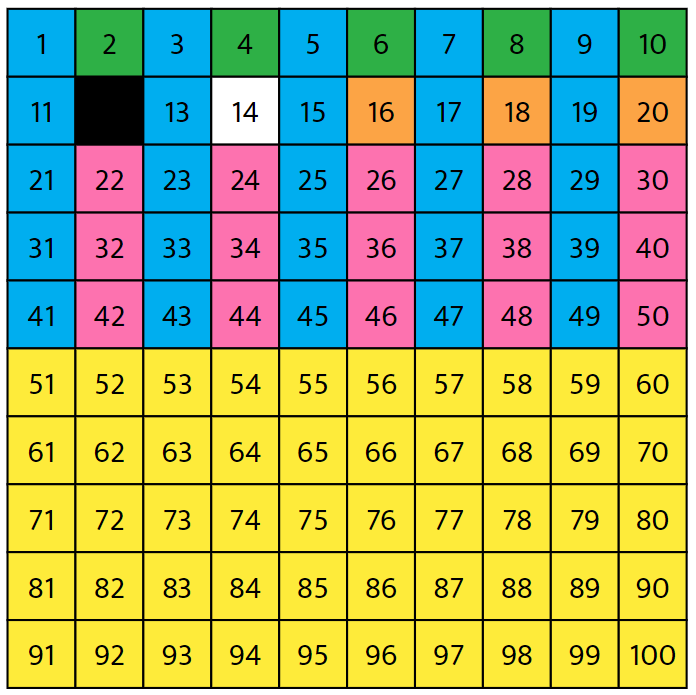
The next stage with this activity is to contrast good guesses such as "Is it lower than 50?" with random guesses such as "Is it 87?" This can then be used as an introduction to algorithms where the aim is to narrow down the options. This is also a good way to introduce the word 'strategy'. A useful website for playing this game is https://toytheater.com/hundreds-chart/. On this site you can eliminate the numbers which have been ruled out using different colours. For example, the mystery number was 14 and the yellow shading was in response to the question, "Is it bigger than 50?". The blue shading was in response to the question, "Is it even?"
 |
|
|
Number generation activity |
- Students choose a number between 1 and 100 and write it in a box in the middle of a sheet of paper (e.g., "25")
- Students think of different ways to get this number and write them all over the page (e.g., 10 + 15; 5 x 5, 20 + 5, 30 - 5, 10 + 10 + 2 + 3, and so on).
Algorithms and pseudocode
Pseudocode is an informal description of steps using
natural language intended for human understanding rather than machine
execution. It uses elements similar to coding but without adhering to
the strict syntax rules of any specific programming language.The
following video (4:58) explains algorithms using a counting example and
pseudocode.
Branching
In algorithms and coding, branching is when a single branch is subdivided into two or more branches. Branching is used to make decisions and follow different paths of code based on conditions. Terminology for branching includes "if/else", "if/then", and even "yes/no". The following screenshot uses yes and no to show how to safely cross a road.
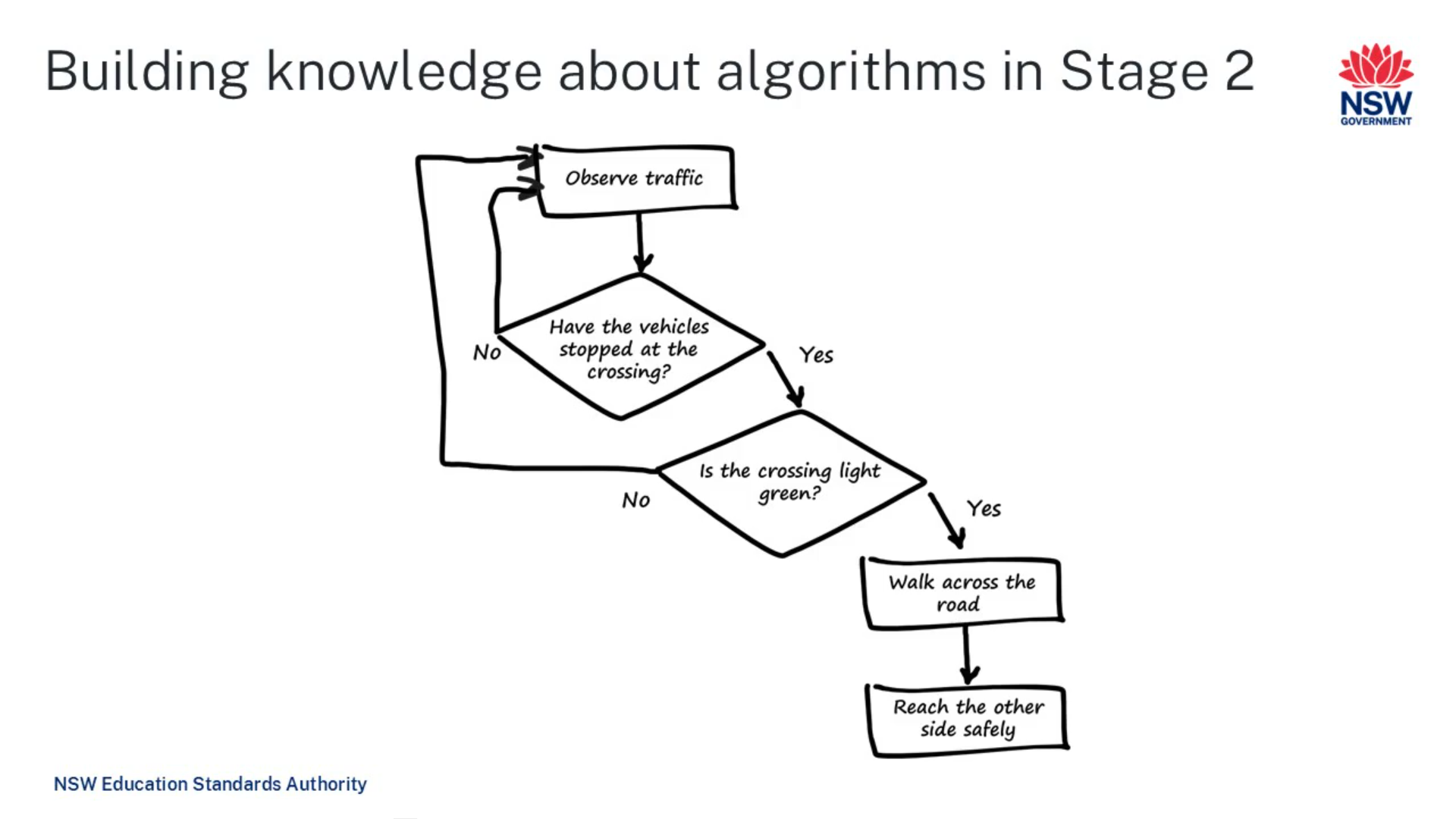
(Screenshot from https://players.brightcove.net/2750693524001/default_default/index.html?videoId=6385325199112)
|
Word search activity |
|
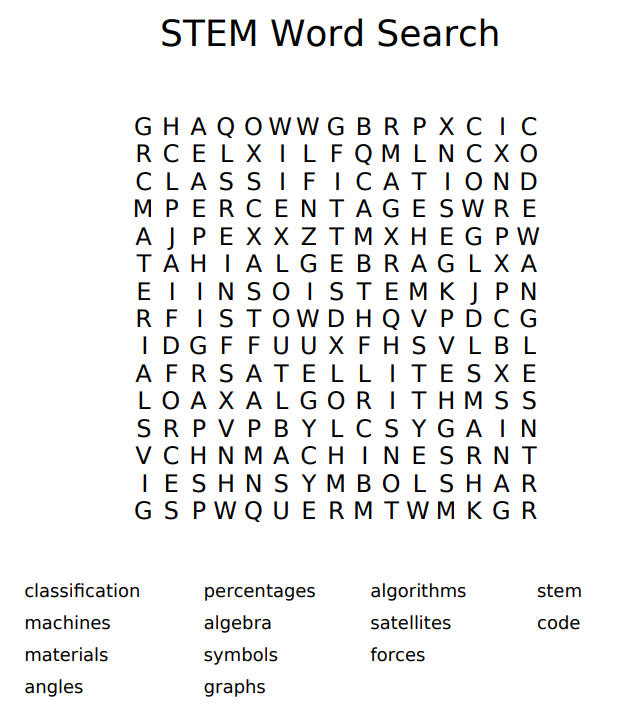
Create an algorithm to solve word searches using pseudocode |
- This challenge is open ended as there is a whole range of appropriate ways to address this.
- The main criteria is that each child's algorithm is logical and sequential.
Tessellations
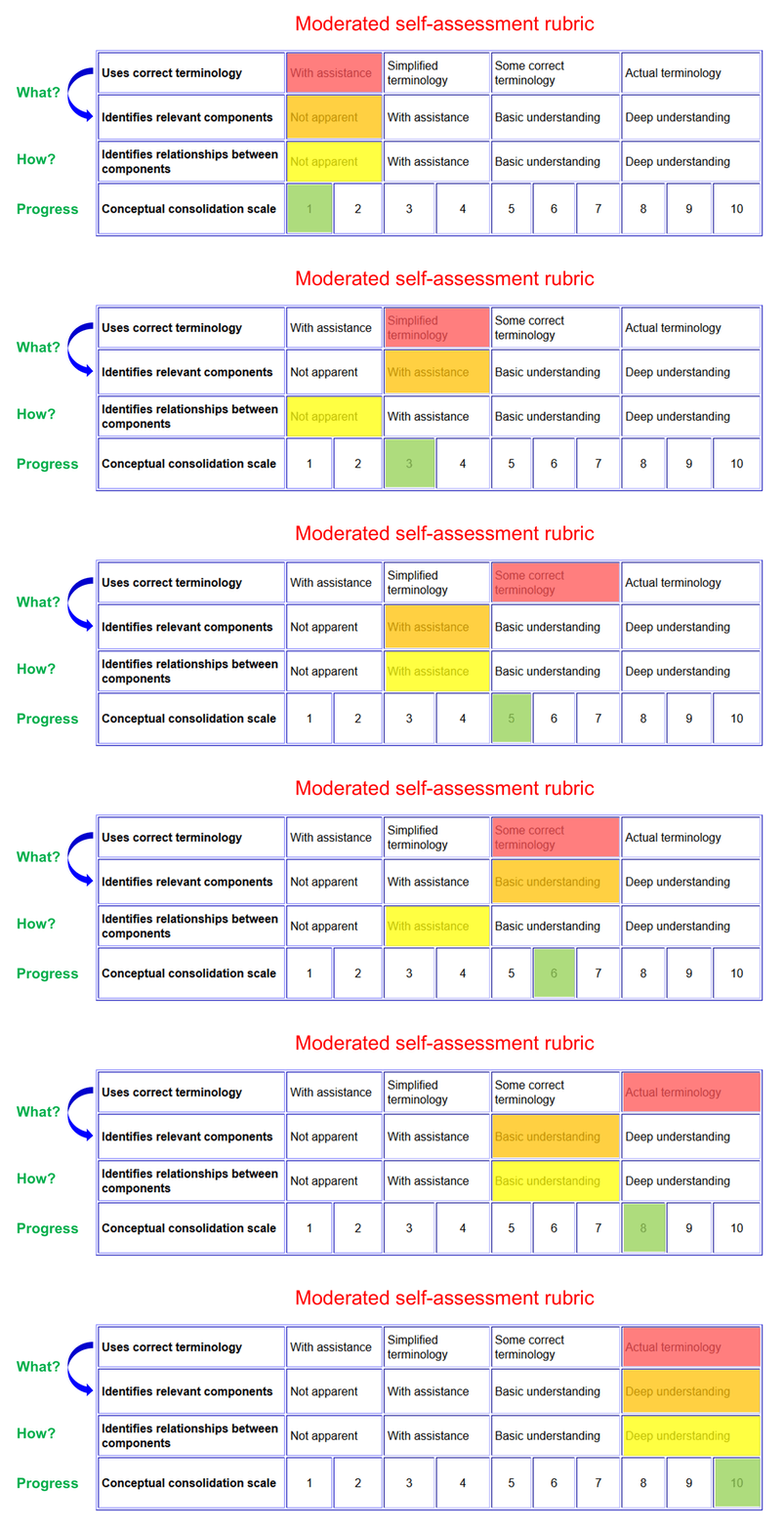
Moderated self-assessment
Discussions with students around the key components of conceptual topics and how they fit together can generate insights into student achievement.
We welcome your feedback and suggestions
The chief investigator for The SILO Project is Associate Professor Brendan Jacobs, Head of Department STEM Education, University of New England. The SILO Project thrives on incremental improvement so constructive feedback is greatly appreciated. Please contact Brendan via email at bjacobs7@une.edu.au to share your thoughts and recommendations.

This work is licensed under a Creative Commons Attribution-NonCommercial-ShareAlike 4.0 International License
Main menu